The Measured Twinkle: Making a Christmas Shopfront Pay for Itself on Exmoor
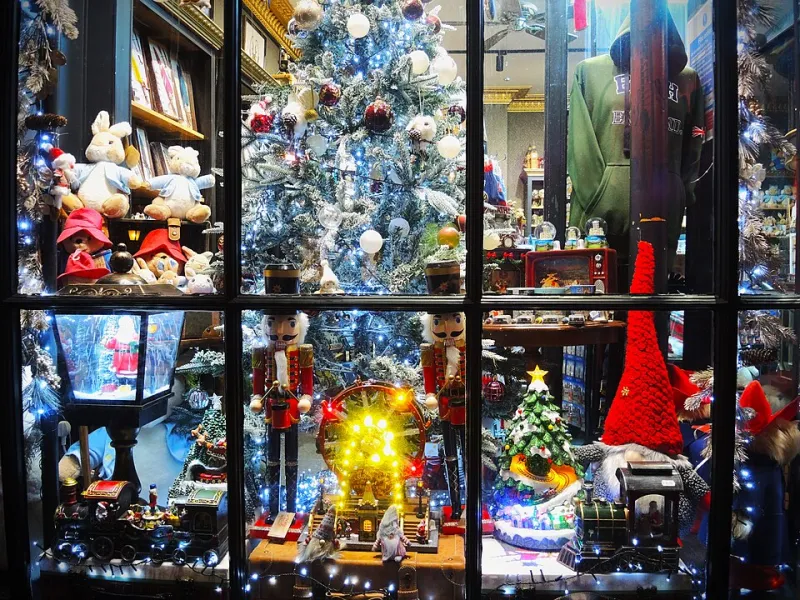
Photo: Neil Owen , CC BY-SA 2.0, via Wikimedia Commons
By mid-November on Exmoor, the dark arrives before the school run is finished. That makes your shopfront do more than advertise a product: for a few weeks it becomes the brightest thing on the street. The temptation is to treat the Christmas window as a decorating competition. The better approach for a small trader is to treat it as a quiet, hard-working member of staff — one that welcomes people in, looks good in photographs and gives you something to measure beyond a warm glow.
This is not about spending less for the sake of it. It is about spending deliberately. A few well-placed lights, a clear doorway and a late-night opening with a proper reason behind it will usually beat a window full of glitter that nobody can see past.
Start with the door, not the fairy lights
The most festive window in the world is no use if the entrance looks awkward. Before you unwrap a single length of tinsel, stand outside your shop at dusk and look at it the way a customer would. Can you see the handle? Is the step obvious? Are there cables trailing across the threshold? Would someone with a pushchair, a walking stick or a wet dog feel confident coming in?
Exmoor's high streets are full of old buildings with character, and character often means uneven floors, narrow doors and a step that has been there since before anyone can remember. You cannot rebuild the shop in November. You can, however, keep displays back from the glass so people can see inside, route any cables safely, tape down anything loose and make sure the light does not glare into the eyes of someone approaching the door.
If you use second-hand lights or inherited decorations, give them a quick check. Frayed flex and cracked plugs are not worth the risk. For anything that plugs in, a simple PAT test is cheap insurance, and timers are your friend. They save you remembering, they stop lights burning all night and they make the whole thing feel more considered.
Low-energy lighting that still looks warm
A Christmas window does not need to be visible from the moon. Warm white LEDs, a couple of discreet spotlights and perhaps one focal piece will usually do more for a small shopfront than a tangled cascade of coloured bulbs. Look at what you already have: a desk lamp, a shelf spotlight, a string of lights from last year. Reuse first, buy second.
Work out the running cost before you fall in love with a lighting plan. A 20-watt LED display running for five hours a night is using 0.1kWh per evening. At a typical small-business electricity rate, that is pennies, not pounds. A old set of 200 incandescent bulbs is a different story. If you are unsure, a plug-in energy monitor will tell you quickly enough.
Timers are worth the small outlay. Set them to come on at dusk and go off after closing, or after the late-night shoppers have gone home. There is no prize for being the last window lit in Dulverton at two in the morning. Keep the display away from direct heat, keep cables out of walkways and do not overload sockets. If you are renting, check your lease before fixing anything to the frontage.
Make it photographable after dark
Most customers will see your window twice: once in person and once on a phone screen. A display that photographs well is not vanity. It is free marketing. Clean the glass inside and out, because a smear shows up more than a missing bauble. Take your photographs at dusk rather than pitch dark, when there is still a little blue in the sky and the window lights can hold their own.
Steady your phone against a doorframe or use a cheap tripod. Turn off the flash. Take one wide shot of the whole window, one close-up of a detail and one showing the doorway, so people know exactly where to come in. Post them on your social accounts with the village or town name, your opening times and a plain description of what is inside. A line like "Open until 7pm on Thursdays in December — mulled apple juice and gift wrapping at the counter" is worth more than a caption full of emojis.
If several businesses on the same street are dressing their windows, agree a simple hashtag or a shared post. A cluster of photographs from Porlock, Lynton or Minehead looks like a place worth visiting. One lone photo looks like a shop with tinsel in it.
Give the late-night opening a job to do
Opening late because it is Christmas is not an offer. Opening late with a reason, a time limit and something to count is. That reason can be modest: a late-night shopping evening, a local choir singing outside, a free gift-wrapping table, a tasting of Exmoor produce, a discount on a specific line or a chance to order by a certain date for collection before Christmas.
Make the offer easy to record. If you hand out a voucher, number them. If you offer a discount for people who mention the window, keep a tally sheet by the till. If you run a prize draw, use the entry forms to ask one useful question: "How did you hear about us tonight?" You will learn more from fifty honest ticks than from a month of guessing.
Be realistic about staffing. A late opening with one person on the till and a queue at the door is not a welcoming experience. If you are a café, decide whether you are serving full meals or just drinks and cake. If you are a shop, decide whether you want browsers or buyers. Either is fine, but you need to know which one you are set up for.
Measure the window without a spreadsheet degree
You do not need a retail analyst to tell you whether the display worked. You need a few simple counts, kept consistently. Write down the number of people who come in during the late-night session. Note the receipts for that evening and compare them with a normal Thursday. Keep a note of the weather, because a wet night on Exmoor will change everything.
Ask new customers how they found you, and jot down the answers in a notebook by the till. Count how many vouchers come back. Check how many times your window photographs were shared or saved. If you have a door counter, use it. If you do not, a simple tally in fifteen-minute blocks during your busiest late opening will tell you more than you might expect.
Keep the whole exercise small enough to survive December. A daily note of three things — footfall, takings and one customer comment — is enough. At the end of the season you will know whether the window brought people in, whether they bought anything and whether the late-night opening was worth repeating.
The shopfront that earns its keep
A good Christmas window is not the one with the most lights. It is the one that makes a cold, dark evening feel like an invitation. It is safe to walk into, cheap enough to run, easy to photograph and tied to an offer you can actually count. Done that way, the tinsel is not decoration for its own sake. It is part of the till.